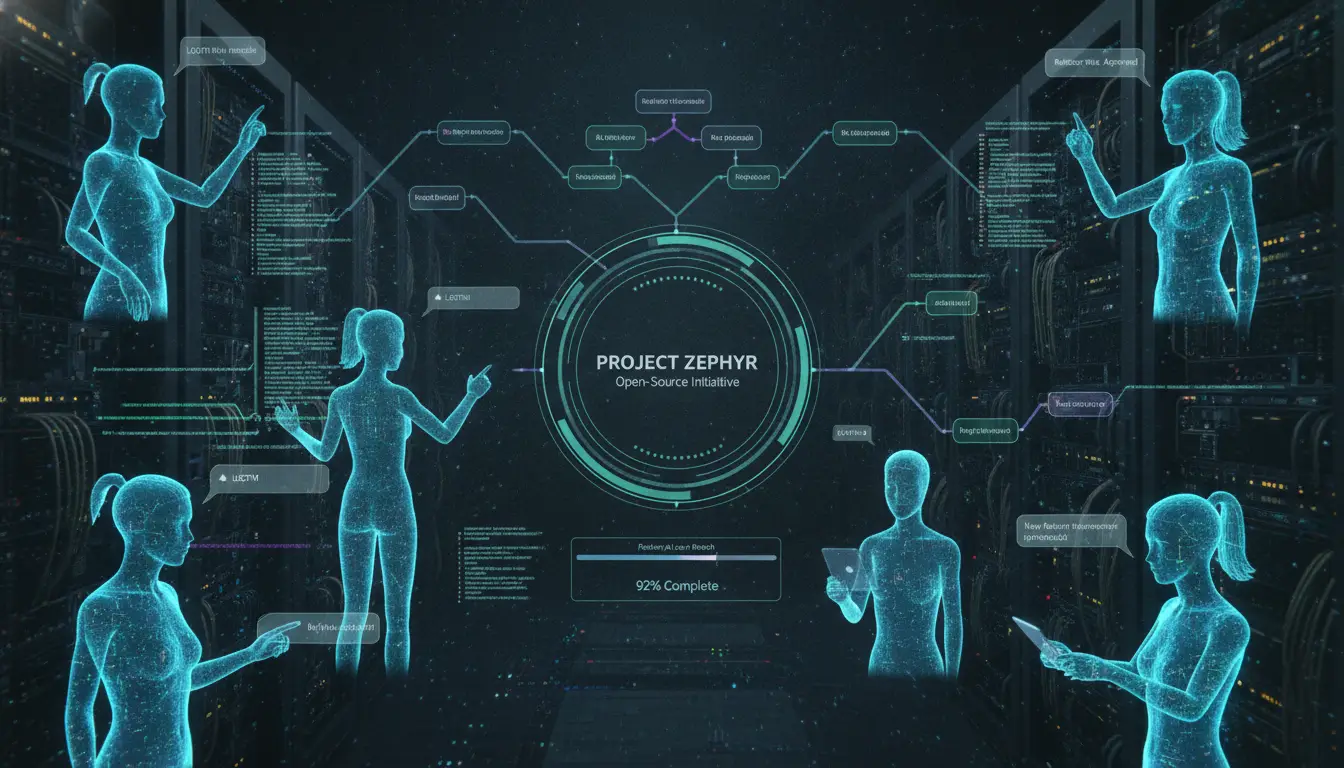
Maintaining open-source projects requires a blend of technical skill, community engagement, and efficient workflow management. As AI-powered tools become more prevalent, understanding how to integrate them into existing processes is crucial. At developerz.ai, we leverage various AI assistants to streamline our operations. This post explores our strategy for coexisting with CodeRabbit and GitHub Copilot, ensuring they augment, rather than complicate, our maintainer workflows.
The Role of developerz.ai in Open Source
developerz.ai functions as an autonomous maintainer agent for GitHub projects. Our core mission is to automate the repetitive yet critical tasks involved in project maintenance. This includes triaging issues, communicating with reporters, managing pull requests, and orchestrating releases. Our goal is to free human maintainers to focus on architectural decisions, complex problem-solving, and community building.
Every action taken by developerz.ai is audited and disclosed, ensuring transparency and accountability. We act as a trusted extension of the maintainer team, providing a consistent and efficient presence around the clock.
Understanding CodeRabbit and GitHub Copilot
Before diving into coexistence strategies, it's helpful to clarify the primary functions of CodeRabbit and GitHub Copilot:
CodeRabbit: Automated Code Review
CodeRabbit is an AI-powered code review assistant. It integrates directly into the pull request workflow, providing automated feedback on code changes. Its capabilities typically include:
- Style and Linting Checks: Ensuring adherence to project coding standards.
- Bug Detection: Identifying potential errors or vulnerabilities.
- Readability Suggestions: Proposing improvements to make code easier to understand.
- Complexity Analysis: Flagging overly complex sections of code.
- Test Coverage Analysis: Highlighting areas lacking sufficient testing.
CodeRabbit aims to offload the initial, often tedious, pass of code review from human developers, allowing them to focus on higher-level architectural and design discussions.
GitHub Copilot: AI Pair Programmer
GitHub Copilot, powered by OpenAI's Codex, is an AI pair programmer that provides real-time code suggestions directly within the editor. Its primary features include:
- Code Completion: Suggesting lines or blocks of code based on context.
- Function Generation: Creating entire functions from comments or function signatures.
- Boilerplate Generation: Helping with repetitive code structures.
- Test Case Generation: Assisting in writing unit tests.
- Documentation Assistance: Suggesting comments and docstrings.
Copilot's role is to accelerate coding, reduce boilerplate, and offer alternatives or solutions as a developer writes code.
Integrating developerz.ai with CodeRabbit
Our interaction with CodeRabbit primarily occurs during the pull request lifecycle. When a user submits a pull request, developerz.ai initiates its own review process, which runs in parallel with CodeRabbit's:
- Initial Triage: developerz.ai first performs an initial assessment of the PR, checking for basic compliance with contribution guidelines and ensuring the PR is correctly formatted and linked to an issue.
- Parallel Review: CodeRabbit then provides its automated feedback, focusing on code quality, style, and potential issues within the code itself.
- Synthesizing Feedback: developerz.ai monitors CodeRabbit's output. If CodeRabbit identifies minor, easily addressable issues (e.g., linting errors, simple style deviations), developerz.ai might prompt the user to address them directly. For more substantial or nuanced feedback from CodeRabbit, developerz.ai may summarize or highlight these points for human maintainer attention.
- Actionable Suggestions: If developerz.ai is configured to automatically fix certain types of issues, it might leverage CodeRabbit's findings to generate and suggest patches, or even directly commit fixes in a separate branch for review.
The key is to avoid redundant or conflicting feedback. developerz.ai learns to interpret CodeRabbit's suggestions, distinguishing between automated stylistic checks and deeper semantic concerns. This allows us to escalate only the most critical or human-intervention-requiring comments to the maintainers, while guiding contributors through straightforward adjustments.
Coexisting with GitHub Copilot in Development
While developerz.ai is an agent, not a human developer, its interaction with Copilot is indirect but crucial. When developerz.ai delegates coding tasks to a user's own agent or to a human developer, the expectation is that these developers are likely using tools like Copilot.
- Code Generation Awareness: developerz.ai understands that generated code, whether by humans using Copilot or other AI tools, might have different characteristics. This includes potential for boilerplate, specific patterns, or even subtle bugs that are common in AI-generated code.
- Focus on Outcomes: Instead of dictating how code is written, developerz.ai focuses on the outcomes: does the code solve the issue, pass tests, adhere to specifications, and meet quality standards? The origin of the code (human-written, Copilot-assisted, or fully AI-generated) is less important than its functional correctness and maintainability.
- Reviewing Generated Code: When developerz.ai observes a pull request with code that may have been generated by Copilot, its internal checks for logic, edge cases, and test coverage become even more critical. CodeRabbit's review, in turn, helps catch stylistic inconsistencies or common errors that Copilot might occasionally introduce.
This indirect coexistence means developerz.ai is designed to be agnostic to the specific coding tools developers use, as long as the end product meets the required standards. It essentially creates a robust safety net around potentially Copilot-generated contributions.
Synergies and Differentiators
- Complementary Roles: CodeRabbit focuses on reviewing code quality, Copilot on generating code, and developerz.ai on automating the entire maintainer workflow. They address different stages and aspects of the development cycle.
- Reduced Human Overhead: By combining these tools, we significantly reduce the manual effort required from human maintainers. Copilot accelerates development, CodeRabbit performs initial code scrutiny, and developerz.ai orchestrates the entire process, including communication and decision-making.
- Consistency and Standards: CodeRabbit helps enforce standards through automated reviews. developerz.ai ensures that these standards are communicated and adhered to throughout the PR lifecycle, prompting contributors to fix issues identified by CodeRabbit.
- Faster Iteration: Automated feedback loops enable developers to iterate more quickly, addressing issues identified by CodeRabbit or refining Copilot-generated code without waiting for a human maintainer's initial pass.
Challenges and Future Outlook
While highly beneficial, coexisting with multiple AI tools presents challenges:
- Avoiding Redundancy: Ensuring that developerz.ai's own checks don't overlap unnecessarily with CodeRabbit's, or that Copilot's suggestions don't conflict with project-specific guidelines enforced by developerz.ai.
- Contextual Understanding: AI tools still struggle with deep contextual understanding and nuanced design decisions. Human oversight remains essential for complex changes.
- Tool Evolution: All these tools are rapidly evolving. developerz.ai must continuously adapt its internal models and integration points to keep pace with new features and capabilities.
Our future efforts will focus on refining the decision-making processes within developerz.ai to better interpret and act upon feedback from CodeRabbit, and to provide even smarter guidance to developers who are using Copilot. The goal is to create an even more seamless and efficient development and maintenance pipeline.
Takeaway
Effective open-source maintenance in the age of AI requires smart integration. At developerz.ai, we don't see tools like CodeRabbit and GitHub Copilot as competitors, but as powerful allies. By understanding their strengths and integrating them strategically, we create a more efficient, consistent, and less burdensome environment for maintainers, allowing them to focus on innovation rather than administration. This synergistic approach maximizes the benefits of AI, making open-source development more accessible and sustainable for everyone involved.